Sunday, March 9, 2014

Well, so...


I've been wanting to use that clip on my blog forever. I think it captures the ambiguity involved in Peace Corps work. I know you have all thought at one time or another, "ohh, so she's a Peace Corps volunteer! So, uh, that means..." And I have definitely thought to myself, "wait, what is it that I do here?" over the past year. Before I got here, I really really didn't know what I was getting myself into going to do here.

It's taken me a while to write this post because I've been waiting to have a marginally substantial answer. I've written a bit about nutrition work in this sappy post and talked about Peace Corps goals 2 and 3 in this post, but I haven't really said much about what kind of work (goal 1 work, that is) a Health Extension Volunteer does.

Naturally, the work you do here varies by person, by site, and by country. Peace Corps is, by nature and design, both a top down and bottom up organization. Its essence is grassroots on-site work with Peace Corps Volunteers identifying and filling needs, mostly through building the capacity of host country nationals. After all, Peace Corps goal 1 is "to help the people of interested countries in meeting their needs for trained men and women." But Peace Corps is also (increasingly, I believe) working as a top-down organization. We are trained in specific areas and assessed in our completion of tasks. I am a health extension volunteer, so I am given a framework with three goals relating to malaria, maternal and child health, and water and sanitation. A total of 31 indicators mark and track my progress towards completion of these framework goals. Some people love the rigidity of the top down aspect, some people hate it. As a pre-med who majored in Gender and Sexuality Studies, I'm fairly used to sometimes contradictory forms of experience expression or the often messy intersections of quantitative and qualitative data. I guess I'd say I enjoy the way Peace Corps is structured these days. Tangential trajectories aside, this is the situation a Peace Corps volunteer starts with.

Then you are dropped in the middle of nowhere with a village of very nice complete strangers and you go from there.

These are things I have done or am working on right now:

Case de Sante (also called a Health Hut)

Getting the Case de Sante* up and running is my primary work in village. I took a long time to start this because I wanted to feel out my village's commitment and make sure the project would live on far beyond my time here. Up until now I've been working with the health workers (called relais) on their duties, just without a functioning central structure. Luckily, I have a wonderful village and great relais and we are finally really ready to get the Case open. I will be posting a "before" picture soon, hopefully followed by an "after" in a few months. Materially, we need furniture, paint, basic medications,and  trees and an outdoor structure for shade. Functionally, we need the relais to come to work every day and we need the village to be aware of us as a reliable resource. (Opening day party? I think so.)

Causeries, Weighings, and a Hearth Model

As I mentioned above, I have been working with the relais on the usual Case duties even though we don't have a functioning Case. The biggest part of this was getting the Health Committee in my village to communicate with each other and the village, an ever ongoing project. Information transmission seems to be extremely difficult in Senegalese culture, and it's not just me or because my language is bad. I can't tell you how many times people have complained to me about not hearing about things. "O tinani kam" ("s/he didn't inform me") is one of the most common phrases in my host mom's vocabulary. So, one of the first things we started was monthly meetings for the Health Committee to plan all of the monthly activities together. It has worked fairly well, but is still a struggle to keep it regular and we are still working on the best way to inform the village about activities. Hopefully having a working structure where we can base our efforts will help those problems in the future.

Once we do have a schedule set, things go fairly smoothly. We have about two causeries each month on topics like exclusive breastfeeding, diarrhea, family planning and nutrition. We have monthly baby weighings  and every three months we go house to house for arm band measurements. We schedule in regional and national events like vaccinations and bed net distributions. We are struggling on the consultation side and many women go to our Poste de Sante for birth control instead of talking to our relais, again something that should hopefully improve with an open Case.

SeneGAD

I am pleased to announce that I have recently been elected as the Senegal Gender and Development Board (SeneGAD) President! The elections occurred at SeneGAD's 6th annual West African Gender and Development Conference coupled with the quarterly SeneGAD meeting, both held in Thies. See, you thought that majoring in Gender and Sexuality Studies would never come in handy! Far from it! I have found a position amazingly, beautifully, fantastically tailored to my interests and experiences and I couldn't be happier.

For more on SeneGAD, visit http://senegad.wordpress.com/

So far as president I organized a radio broadcast of Senegalese Peace Corps staff talking about women's issues for International Women's Day. The spot was recorded in three different languages and sent out to PCVs for use on their local radio. Here is me and SeneGAD Communications Coordinator Juliana at our radio in Ourossogui.
It was sunny out

Next up is the April Quarterly Meeting, a GrassrootSoccer partnership training, the Michele Sylvester Scholarships and a whole bunch of other things I'll save for another post.

Girls Camp

March 27th-31st is the Matam region's annual Girls Camp! All of the Matam volunteers invite girls from our villages to a five day camp in Ogo where we talk about staying in school, goal setting, reproductive health, domestic violence, and life skills. We also do fun stuff like making collages and friendship bracelets, doing dance routines, and watching movies. These are topics that girls here almost never get to explore or learn about and it is a favorite Peace Corps experience for many volunteers. I am co-coordinator this year and I can't wait for it to happen. Stay tuned for a blog post about this special event.

Malaria Tourney

Before I know it, its going to be June with Ramadan and after that July with rainy season. A fellow PCV and I are currently writing a grant to visit up to 10 villages to talk to people about bed nets, rapid diagnostic tests, signs of simple and grave malaria, and precautions to take when you are pregnant.

Trees

If you have seen any pictures of my village or of Northeast Senegal in general, you know that there are few to no trees. I started a moringa intensive bed at my Case de Sante and will be working on a 400 tree pepiniere for the Case and the elementary school soon. Getting trees to grow in the desert is a serious undertaking so this is a pretty big project for me.

Well Project

I have talked to some people about a well project in my village and as eager as I am to improve water sanitation and village hygiene practices, this one is going on the back burner for now. I may return to it next winter depending on how everything else goes, or I may leave it for my replacement.

Books

I read a LOT in village. When I am at my busiest, my work includes house to house tourneys, village meetings, and travel here and there for supplies. It can be exhausting, but some days it can really only take a few hours... for example, if I have a big meeting in village it is a big deal and can mean a lot of progress, but that only happens every couple months and it only really takes 3-4 hours. I have 20-21 more hours to kill that day. I do other village-y things like pull water, water my plants, and sew blankets but I also do a lot of reading. My book count since May is around 40.


Whew. Well, this list will probably change (and hopefully grow) as I go on, but hopefully it gave you a taste for the kinds of things a health volunteer can do in Peace Corps Senegal. Back to village now to keep working!


*The Case de Sante is a fixture of the health system that works on the village level. Larger towns and cities have hospitals that can do surgeries, have more complex equipment and have trained doctors. The next rung down is the Poste de Sante, present in towns and usually overseeing a large local area (my local Poste is 4km away and covers 11 other villages around us) and is staffed by what we would consider a nurse. They organize vaccination tourneys, treat minor wounds, have consultations, have a maternity ward staffed by a trained midwife, prescribe medications and have an attached pharmacy. The Health Hut/Case de Sante is the lowest health structure present in some villages (but not all) and staffed by volunteers trained in basic health issues. The Case is supposed to diagnose and treat the most common ailments found in village, such as diarrhea or malaria, do baby weighings and monitor malnutrition, consult on family planning, and give health demonstrations (causeries). I say that a Case is "supposed" to do these things because while the model makes sense, getting everything actually functioning can be a challenge. There are breakdowns in the system at every level (don't even get me started about the medication distribution clusterfuck) but especially when the entire structure relies on volunteers like a Case does, reliable work can be tricky. 

Sunday, February 2, 2014

Wait, what am I doing here?

I haven’t written in a long time, I know, I’m sorry. I have a million ideas for posts building up in my head, but for starters, I wanted to update everyone on what I have been up to recently.

Now, Peace Corps has three goals that summarize the mission of the organization and the work of volunteers all over the world. Impressively, these goals have remained unchanged for the entirety of Peace Corps’ existence, which speaks to the purity and long-term utility of the goals. They are:

1. To help the people of interested countries in meeting their needs for trained men and women
2. To help promote a better understanding of Americans on the part of the peoples served 
3. To help promote a better understanding of other peoples on the part of Americans

I am going to have to be a bit more organized in order to write a blog of my work towards goal number one. This is what is typically considered the ‘work’ portion of my service, in the most literal American sense. I talked a little bit about the hearth project I did in my last post, but I promise a more extensive account will be coming soon.

Apologies and excuses aside, I wanted to write a bit about the work I have been doing towards goals two and three recently. The cultural and diplomatic exchange that is embodied in these goals often gets overlooked. We are Americans, and work with billable hours and quantifiable outputs is typically the only currency of productiveness that we accept. Even within Peace Corps we have to twist to turn our experiences into numbers so that Washington can understand our value and work as volunteers. (If this sounds a bit ridiculous to you, it should. If it doesn't, please read my last post and let me know how to best express that in numbers.)  

My service thus far has gone a long way to change my views on this, to say the least. A large portion of my job is earning the trust and support of my community, which is completely necessary and sounds great, but in reality it translates to a lot of sitting, a lot of drinking tea, a lot of simple conversations. At first, like most any American, this drove me crazy. Where was my desk? My checklist for the day? My papers, my completed reports and activities? What was I doing? But then, slowly, I learned the value of sitting with my family by the fire, of holding babies, and making fun of the middle school boys with the middle school girls. I've embraced goals two and three whole-heartedly recently, and I've had an amazing time doing it. I've accepted at this point in my service (almost a year in!) the truth that my village will give me far more than I will give them.

I still hope, however, that even if my more tangible projects fail I will have been a  positive representation of America and Americans. With foreign wars, cultural ignorance and misguided giving, there are a lot of things going against the American image these days. Every country immediately surrounding Senegal has been closed to Peace Corps volunteers because it is no longer safe for Americans to be there. My village is in a corner of Senegal bordered by Mauritania and Mali, and when groups from those countries come to Senegal looking for supporters, I want people in my area to remember me. I want them not to remember me for a well I built or money I gave for scholarships, but for kindness and for the fact that I cared to get to know them and learn their ways. And I want to help people back home learn a bit of what I have been so fortunate to learn so far. I am already a changed person because of this country and my work here, and I want to share as much as I possibly can of the wonderful or even the awful parts of my service and my experiences here. Thus, the cultural exchange portion of my service will probably be the most important thing I do here. Whenever I feel alone, or like I'm not getting through to people, or projects are moving slowly or not at all, when I ask myself "wait, what am I doing here?" this is the answer. 

The things I do each day and each week are small. They don't seem like much and to the busy people reading this they probably seem even smaller. But everything I do adds up to the person I am and the person my village gets to know. This week to help promote a better understanding of other peoples on the part of Americans and to help promote a better understanding of Americans on the part of the peoples served I:

Learned how to draw water from the well


 Got way better at balancing water on my head


Learned a complicated sewing stitch from my aunt


Finished sewing a mobula, which is used to carry a baby on your back, and I am sending it to my cousins in America for their new baby. I don't exactly expect them to use it that way, but it totally still counts as cultural exchange. 

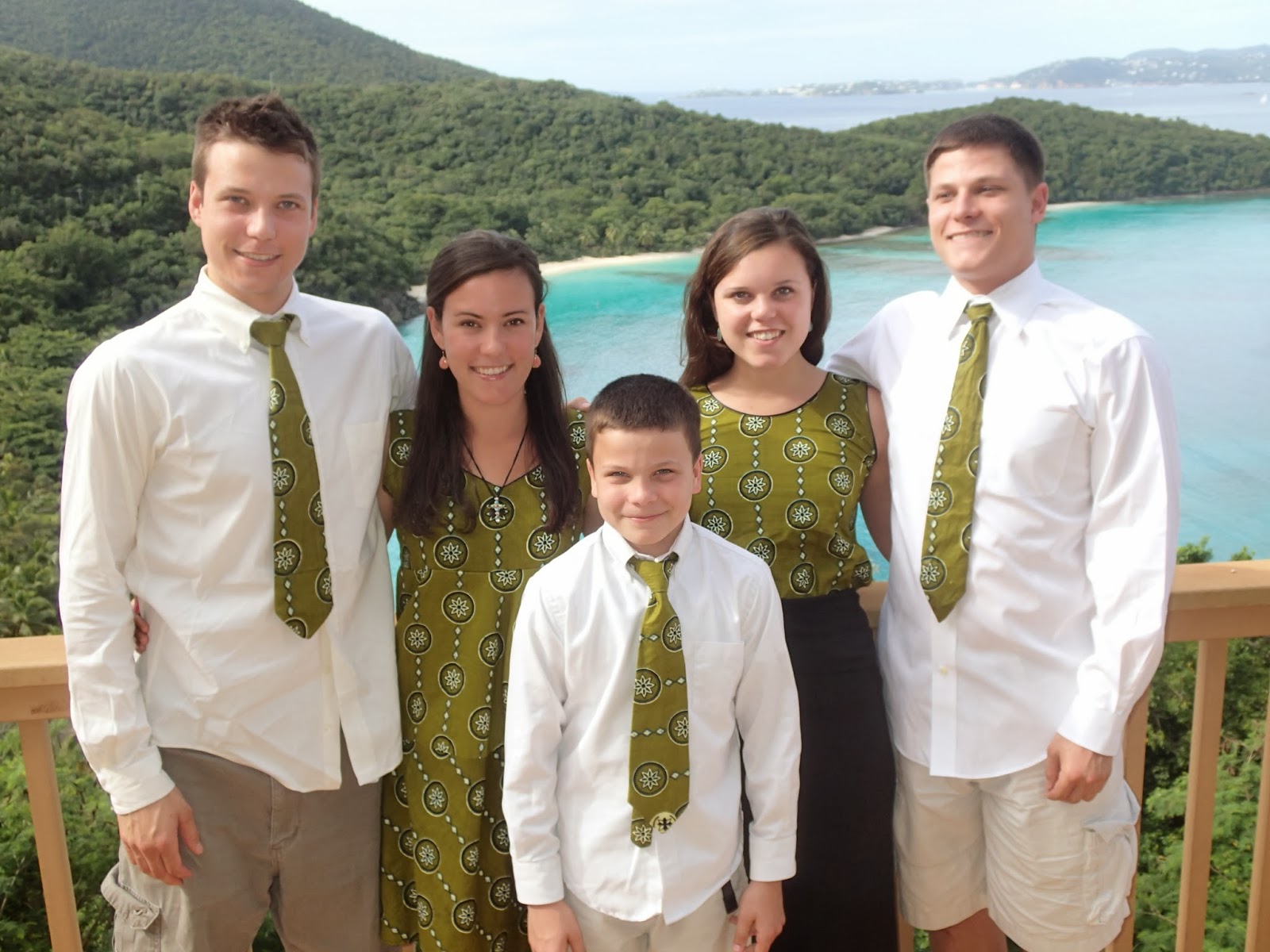
In addition, I do have to also report that I went on a rather heavenly vacation in St. John in the USVI with my family for Christmas. To bring bits of Senegal to them, I gave my family Senegalese gifts for Christmas- Pulaar knives carried by herders (called gaynaakos) for the boys, a purse woven by artisans in St Louis for my sister, a skirt-scarf for my mother, a blanket for my grandparents. In addition, I had American-style clothes made out of Senegalese fabric (in this case, it was actually from Cote d'Ivoire) for the whole family


And then I made one of my favorite traditional meals for my family, maafe gerte (with way more meat than I would ever get in village)


Which my family enthusiastically ate with their hands, kneeling on the ground. 


It was a pretty great success of cultural exchange. I hope you all enjoyed this quick update on some things I've been doing and why it matters. If you have any ideas on how else I can accomplish goals two and three or you want to participate with me somehow, let me know!


Saturday, December 14, 2013

Rougie


One of the foremost strengths of Peace Corps work is that volunteers live in the community they are working with. Unlike other development agencies or almost anyone else devoted to public service of disadvantaged peoples, Peace Corps volunteers can see the problems of their village with greater detail and nuance because they experience it firsthand. 

Peace Corps volunteers also have the opportunity to live with host families, an experience I have treasured and one that brings you even closer to the community. I have come to think of my mothers as my own for the constant care, attention and love they give me. I respect and admire my father. I joke with my sister and delight in her happiness and achievements. I love the babies as if they were my own siblings. 

When I arrived at my site the youngest child was 4 months old, a baby girl named Rougie. I have four younger siblings in America and I have been around many babies in the states, but I have never met one like Rougie. She was the happiest and most joyful baby, smiling and just laughing for the thrill of it every couple minutes with that adorable hiccuping belly laugh that babies have. She was healthy and beautiful and loving. You can see why I fell in love. In the first three months of service volunteers are supposed to hold off on projects to become more integrated into their communities and improve their language, so I spent a lot of my free time with Rougie, enjoying her smile and letting her brighten my day. 


As you may have read in a previous blog post, being sick in Senegal and the ensuing fasting of Ramadan hit me hard. It ended up taking me weeks to feel normal again, and my normal here is significantly weaker and lower energy than my normal in America. I have been totally blown away by the drastic effect nutrition has had on my body. The nutrition at my house actually got worse after that. Before the harvest came in we had a period typically known as starving season. We had our usual plain bread in the morning, and then for lunch we would have a medium to small bowl of rice and half a potato for six people and a baby. Sometimes we got dinner, but for a while it was every other day or every two days. I wish I were exaggerating this. Simply put, I was starving.

But this story isn’t about me. As much as it hurt me and made me unhappy to have so little food, I am a grown woman with years of consuming bountiful healthy food supporting me so my body can handle periods of little food. But for children who are still in development and at vulnerable stages of their lives, it is infinitely more difficult and dangerous. At first I didn’t notice a difference in them. No one ever complained and no one ever said that they were hungry. They played and went to school just as they usually did. But you could tell in little things. They ate frantically when food did come. They cried more often. They slept more. The worst hit by this was of course the littlest, baby Rougie. The first two years of a child’s life are when they are most vulnerable to just about everything, including malnutrition and sickness. Rougie started crying more, a lot more. She didn’t smile or laugh anymore. Her mother, very hungry herself, couldn’t console Rougie and everyone became irritable. Looking back, I didn’t realize why Rougie was crying so much, why she had changed so much from the happy baby I used to know. I thought her mother just wasn’t paying enough attention to her or that she was going through and colicky stage. Towards the end of October her increasingly frail system got sick and she had diarrhea for ten days. Ten days of completely emptying your body when your body is less than 20lbs can be a death sentence. Diarrhea is the number one killer of children under two in this area, and it can happen incredibly fast. I am actually surprised Rougie didn’t get worse faster than she did. It took its toll though. After several days of worriedly watching her and trying desperately to get her to drink ORS, her sickness reached a peak. She started throwing up and couldn’t keep much of anything down. She became listless and couldn’t even hold herself up into a sitting position. I was terrified. I thought we were going to lose Rougie, this tiny beautiful soul that everyone loved so dearly. Her mom and I went to the doctor 4km (2.5 miles) away and he gave Rougie medicine. The next day, she could sit up. She recovered, but she still wasn’t back to her old self. She still cried almost constantly and she didn’t try to crawl or stand up like she had before. She had lost weight over the past month. When I picked her up I could feel her ribs. She had lost a lot of her protective baby fat and you could see it on her tiny frame.

The village health staff and I do baby weighings for children under two years of age in our village once every month. For the month of October we had record numbers of babies whose weight for age put them “in the yellow.” Other children were suffering just like Rougie. 

On the first of November, my work counterparts and I decided to do what is known as a hearth project. My counterpart had heard about it from the Senegalese government organization PRN and I had heard about it from my Peace Corps training, but it was essentially the same thing and is used in many areas where malnutrition is prevalent. Typically you gather a group of 10 to 15 women and their babies and every day one woman cooks while you all talk about proper nutrition and feeding techniques. The children get good food for the duration of the project and the mothers learn how to continue the recipes and practices. For our project we included all the yellow babies who could eat normal food (my counterparts and I strongly advocate for exclusive breastfeeding for the baby’s first six months) in our hearth group and had them come to my counterpart Penda’s house in the evening for 15 days. On the first day we weighed them all to establish baseline weights. We made porridges and rice dishes that were hearty without being too expensive and stressed supervised feeding to the mothers. 

There are two main times a child under two is especially likely to dangerously lose weight. The first is after 6 months when breast milk is no longer enough to sustain the baby and they need to be introduced to other foods. Mothers here feed the babies rice, which has far less nutritional value than breastmilk, or foods that are too adult for their stomachs to handle- things with a lot of hot spices or too much oil. They are also now in danger of getting sick from unclean drinking water or being fed from unclean hands. The second time starts at about a year and a half, when the baby can walk. Mothers and women in general here are extremely busy- just getting water for the day from the well can take 3 hours depending on your family size, not to mention cooking over a fire for as many as 20 people and doing the dishes afterwards, bathing all the children, sweeping the house and yard, doing laundry for everyone, the list goes on. Once a child can walk they are a child of the village and wander and play wherever they please with their friends. How much a toddler is eating or if they are eating at all can get overlooked when they can feed themselves and walk away after Mom gives them bread. They are still at a vulnerable stage of development and can’t quite take care of themselves, but they don’t require the constant attention from their mothers that they used to. The hearth project works on two things to help each of these periods. The first is nutritional, which helps babies of any age, but we specifically teach about foods that are appropriate for young babies to transition to normal solid food. The second focus is the supervised feeding, talking to mothers about overseeing their child’s feeding time and having them practice it for the 15 days. 

I was excited about the project and loved having all the mothers and babies come over in the evenings to eat and hang out. I knew that this kind of project was something I was supposed to be doing as a Peace Corps volunteer and I was happy my village was following through with it. I liked that my counterpart was doing most everything. She was being a leader in the community and I was supporting her, just the role I was supposed to take. I was doing my job, following the book. What I didn’t expect was the drastic change it would have on baby Rougie and how thankful I would be for that. Rougie ate the food ravenously and her mother, initially unenthusiastic about the project, started to watch her more closely and feed her more at lunchtime as well. Before the 15 days were even over I saw a change in Rougie. She stopped crying as much. She started smiling more. She crawled more and started laughing again. She would crawl over to something she had never seen before and just laugh at the joy of discovery. She gained weight and her baby rolls started to come back. In the weeks after, she continued to improve. She was just happier. She would respond to my smile and her mother’s singing. She crawls like a pro now and is starting to climb and stand. She got her first two teeth recently and not even teething has put her out of her naturally sunny disposition. I’m so worried that I am going to miss her first steps. I didn’t fully realize before how much she had changed for the worse when she was sick and hungry. I thought her happiness as a baby just hadn’t lasted through to her toddlerhood. It turned out to be much more than that, but all it took to help her was some knowledge and a little community organization.

The change that I have witnessed in Rougie because of the hearth project is astounding and it gives meaning to all of the work my village does. I know I haven’t written anything in a while and I’m sorry for that, but I hope this post gives some insight to what I have been up to. Sometimes, things are really tough here. Sometimes they end up with an inspiring happy ending. Most times I don’t know what I’m doing. No matter what happens, I am learning a lot and I am surrounded by love.